REVIEW · VIENTIANE
Vientiane Half-Day City Tour
Book on Viator →Operated by Bravo Indochina Tours · Bookable on Viator
Vientiane moves at a gentle pace, and this tour matches it. I like the small group feel, with hotel pickup and drop-off, plus a tight hit-list of top sights like Wat Sisaket’s teak halls and Patuxay’s rooftop views. It is also a great way to orient yourself fast, without feeling rushed through the city.
One thing to consider: while it’s sold as a half day, the timing can run longer than expected, so plan a flexible afternoon or morning around it. Also, the guide experience can vary by person, so bring your questions and make sure you’re getting the answers you want.
In This Review
- Key things that make this Vientiane tour work
- The value: what $89 gets you in Vientiane
- Getting picked up and how the timing really feels
- Wat Sisaket: the quiet masterpiece to start with
- Wat Phra Keo and the Presidential Palace outside view
- COPE: a sobering stop with practical context
- Patuxay: Laos’s Arc de Triomphe and city views on top
- That Luang: the holiest site and the golden spire moment
- The Mekong River finish: easy, local, and low-pressure
- Guides and the small-group advantage (with real names)
- Comfort and practicalities: what to plan for
- Who this tour suits best (and who should skip it)
- Should you book this Vientiane Half-Day City Tour?
- FAQ
- What time does the morning departure pick you up?
- What time does the afternoon departure pick you up?
- How long is the Vientiane half-day city tour?
- What are the main stops on the tour?
- Can you enter the Presidential Palace during the tour?
- Is the tour price including transport and a guide?
- Is there a minimum age?
- Is the cancellation free?
Key things that make this Vientiane tour work
- Wat Sisaket’s miniature Buddha galleries: teak-covered walkways packed with thousands of small statues you can actually take your time with
- COPE and UXO awareness: a stop that explains the lingering impact of unexploded ordnance and the work to clear it
- Patuxay’s climb for panoramic city views: Laos’s Arc de Triomphe style monument, with a chance to get above the traffic level
- That Luang as Laos’s holiest temple site: a 16th-century royal-era landmark with a dramatic golden spire
- Mekong river finish: a calmer end with a stroll along the water and easy snack/drink options nearby
- Max 7 people with A/C transport: less crowding, easier conversation, and a comfortable ride between stops
The value: what $89 gets you in Vientiane
At $89 per person, this is not a “cheap and cheerful” option. But in Vientiane, you’re paying for four things that add up quickly when you’re traveling solo or as a couple: hotel pickup/drop-off, A/C vehicle transport, a professional English-speaking guide, and a curated route through major landmarks.
You also get a sensible structure: start with one of Vientiane’s most striking temples, then pivot to history and memory stops, then finish at two of the city’s biggest visual draws (That Luang and the Mekong). If you’re here for just a day or two, this kind of orientation is often the difference between seeing “a few photos” and actually understanding what you’re looking at.
One practical note: food and drinks are not included. That’s normal for tours like this, but it does mean you should plan on budget and time for a break, especially on the afternoon departure. The river-side ending makes it easier to find a snack or cold drink on your way back.
You can also read our reviews of more city tours in Vientiane
Getting picked up and how the timing really feels
You’ll get picked up right from your hotel in Vientiane. Morning departure starts at 9:00 am, and the afternoon option starts at 2:00 pm. The tour runs about 4 hours (the listing calls it approximately a half-day).
In practice, the experience can feel like it runs a bit long for a strict calendar half-day. That’s not unusual when you have multiple stops with walking, photos, and explanation time. My advice is to treat it as a 4-hour block in your day, then keep your plans flexible for before or after.
Group size is capped at 7 people, which matters more than you’d think. A small group helps you ask questions without waiting your turn, and it makes it easier for the guide to adjust pacing if the group moves at different speeds.
Wat Sisaket: the quiet masterpiece to start with
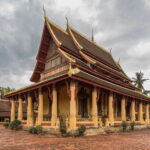
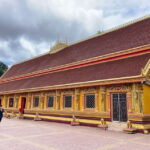
The tour begins at Wat Sisaket, described as the only temple left intact after the Siamese (Thai) invasion in 1828. That historical anchor matters because it changes the way you look at the place. This isn’t just a pretty temple stop; it’s a survivor.
What you’ll notice right away is the building style and the repeated pattern of tiny figures. The tour highlights the breezy teak-covered hallways filled with thousands of miniature Buddha statues. The visual effect is both orderly and a little mind-bending in the best way: you can keep scanning and still find something new.
A tip for getting value here: slow down for the hallway views. The temple is one of the best places on the route to let your eyes adjust and to actually take in the craftsmanship rather than rushing to the next photo.
Wat Phra Keo and the Presidential Palace outside view
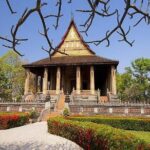
Next up is Wat Phra Keo, used as a religious museum. The focus here is art—both Lao and Khmer works. If you’ve been bouncing between markets and streets, this stop gives your brain a place to land. You’re looking at how different cultures expressed religious art across time.
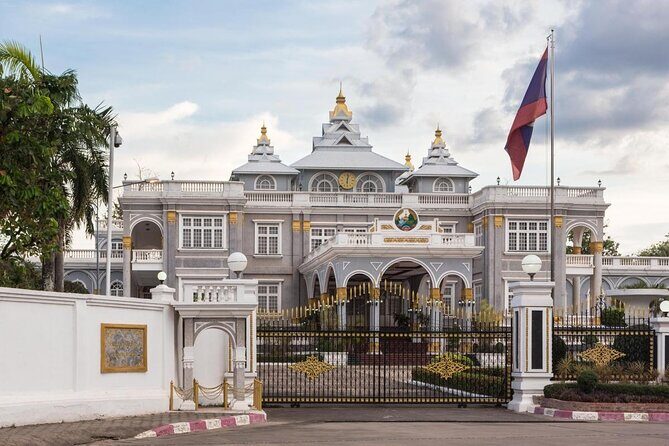
Nearby is the Presidential Palace. The key detail: you are not allowed to visit inside. Still, this is a useful stop because it gives you a glimpse of Vientiane’s colonial-era past. From the outside, it helps you connect the city’s monuments to the layers of rule and influence that shaped the capital.
If you want the most out of these two stops, ask your guide to connect them: how religious art and political architecture sit next to each other in the same city. That kind of explanation is often where the tour goes from “sightseeing” to real understanding.
COPE: a sobering stop with practical context
Then comes COPE, an association focused on helping landmine victims. The visit includes in-depth information on the history of the American/Vietnam war and the lasting impact of unexploded ordinances (UXO) in the area.
This is the emotional anchor of the tour. It can feel heavy compared with the more straightforward temple-and-monument route. But it’s also one of the most meaningful additions, because it explains why certain places look the way they do, why safety and clearance matter, and what “history” means when it affects everyday life.
If you’re the type who prefers short explanations and quick photos, this may take a slightly different pace than you expect. If you’re open to it, it’s one of those stops that gives your whole Vientiane visit a sharper lens.
A few more Vientiane tours and experiences worth a look
Patuxay: Laos’s Arc de Triomphe and city views on top
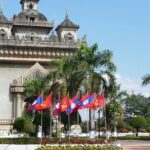
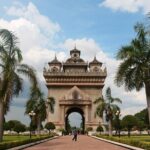
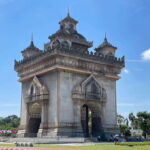
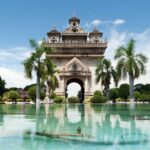
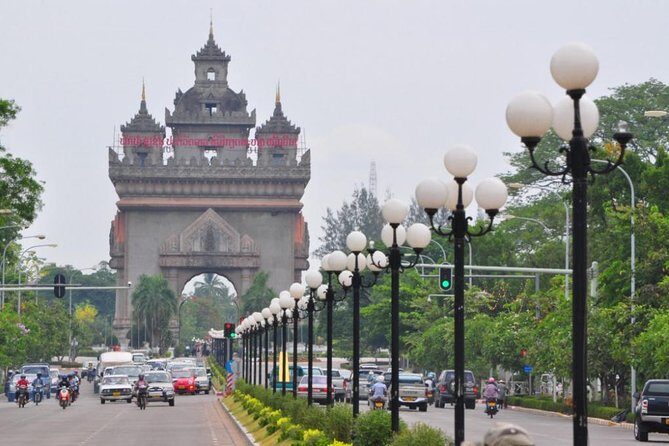
After COPE, you head to Patuxay, which is often described as Laos’s version of the Arc de Triomphe. The big feature here is that you can climb the stairs to the roof for sweeping panoramic views of the city.
This is a great mid-tour reset. You’ve been walking through historical spaces and museum-like settings; now you get height, angles, and a way to “read” the city from above. It also helps you connect where you are with where you just were, which makes the Mekong ending more satisfying.
Photo-wise, prioritize roof-level shots that show the monument’s position and lines leading away from it. If the weather is clear, this stop delivers some of the best “wide view” moments of the day.
That Luang: the holiest site and the golden spire moment
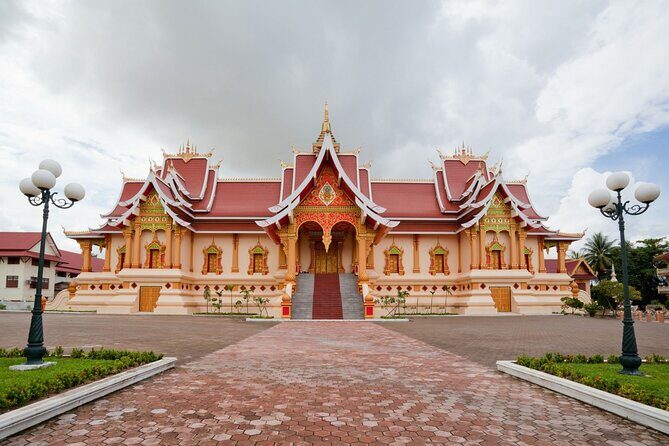
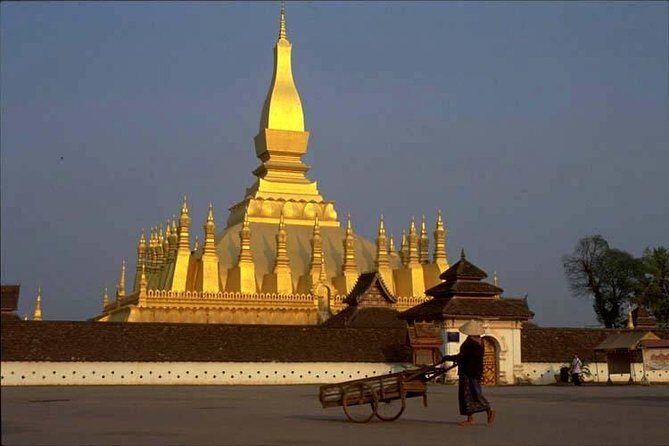
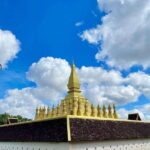
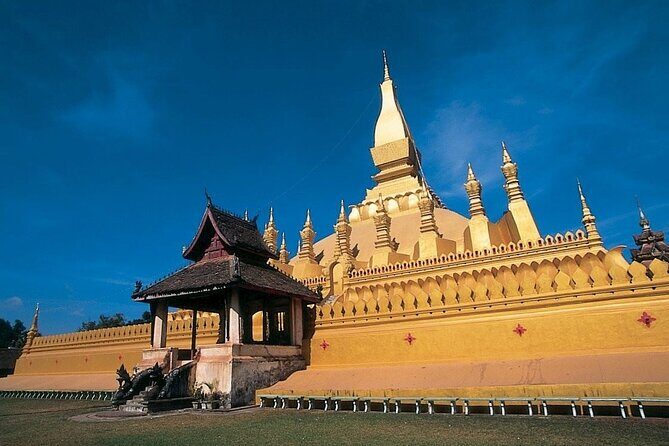
Your tour ends at That Luang, described as the holiest site in Laos. The route notes its construction by King Setthethirat in the 16th century, which gives you a strong time frame. And the star of the show is the towering golden spire.
Even if you’ve seen gold spires before, That Luang has a sense of scale and importance that makes it worth the effort. In many cities, the biggest religious sites can feel “too big to understand.” That Luang is different in that it’s one of the clearest points on a half-day route: you can step back, look up, and instantly get why it’s central.
If you’re chasing photos, this is your moment to do more than snap and move on. Take time to appreciate proportions. You’re not just photographing an object; you’re photographing a national symbol.
The Mekong River finish: easy, local, and low-pressure
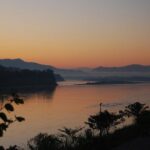
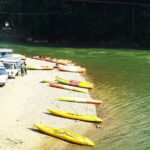
The final stop is along the banks of the Mekong River. This is one of the smarter ways to close a day of monuments: after all the stone, art, and history, you get open air and a calmer pace.
The tour plan includes time to stroll and enjoy the riverside atmosphere. You can also stop for a cold drink or sample a snack from local food stalls nearby. Then you get transferred back to your hotel.
This ending is especially useful if you’re traveling as a couple or solo. It gives you a natural “where next” moment: you can either keep exploring the riverside areas on your own after the drop-off or rest without feeling like you missed something.
Guides and the small-group advantage (with real names)
The biggest factor in a tour like this is the guide. On this route, you’ll see a range of guiding styles, and the strongest experiences tend to have one common thread: clear explanations tied to what you’re seeing.
For example, guides such as Mr Go have been highlighted for solid English and strong knowledge of Laotian culture and the sites. Others like Parn and Lotty have been praised for being friendly, accommodating, and for explaining things in a way that makes the stop make sense. And when Xaiixana Mahavong is leading, the emphasis is often on history and location context in a way that keeps the tour lively without turning it into a lecture.
My practical takeaway: because group size is capped at 7, you’re in a good position to ask follow-up questions. Don’t wait until the end. If you’re confused about something—political context, temple significance, or why COPE matters—ask early so the rest of the route clicks.
Comfort and practicalities: what to plan for
You’ll ride in an A/C vehicle, with professional English-speaking guide support. Pickup and drop-off are included, so you’re not dealing with finding transport between widely spaced sights.
Still, plan for what’s not included:
- Food and drinks aren’t part of the price, so budget for at least a snack or drink during the river segment.
- The tour involves multiple stops, including walking at temples and a stair climb at Patuxay, so wear footwear you’re comfortable moving in.
Also, bring your phone number you can be reached at when booking. The tour notes you should provide a contact phone number on the road, which helps ensure pickup goes smoothly.
Who this tour suits best (and who should skip it)
This tour fits best if you want a first-time orientation to Vientiane and you like a guided route that connects major landmarks into a story. It’s also a good choice if you don’t want to arrange transport across several sites on your own.
It’s less ideal if you’re chasing a super long day of in-depth museum time, or if you have tight schedule constraints where an unexpected time drift would ruin your plans. The tour is designed for efficient seeing, not for staying until you feel fully “done” with each place.
Should you book this Vientiane Half-Day City Tour?
If you’re visiting Vientiane and you want the highlights—temples, major monuments, a meaningful stop at COPE, and a Mekong finish—this is a solid value for the money because pickup, transport, and a guide are all built in. The small group size helps a lot, and Patuxay plus That Luang give you standout visual payoffs.
I’d book it if you can treat it as a flexible 4-hour block and you’re comfortable with the day including a serious topic at COPE. Skip it only if you need a strictly timed half-day with zero schedule drift, or if you prefer independent travel where you control every minute.
FAQ
What time does the morning departure pick you up?
The morning tour starts with hotel pickup at 9:00 am.
What time does the afternoon departure pick you up?
The afternoon tour starts with hotel pickup at 2:00 pm.
How long is the Vientiane half-day city tour?
The duration is about 4 hours (approx.).
What are the main stops on the tour?
You’ll start at Wat Sisaket, then visit Wat Phra Keo and the Presidential Palace area, stop at COPE, go to Patuxay, see That Luang, and finish along the Mekong River.
Can you enter the Presidential Palace during the tour?
No. You are not allowed to visit inside the Presidential Palace, but you do get a glimpse from outside.
Is the tour price including transport and a guide?
Yes. Hotel pickup and drop-off, A/C transport, and a professional English-speaking guide are included. Food and drinks are not included.
Is there a minimum age?
Yes. The minimum age is 12 years.
Is the cancellation free?
Free cancellation is available. You must cancel at least 24 hours before the experience start time for a full refund.